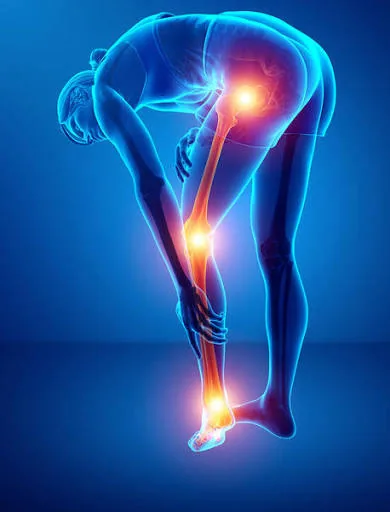
Knee/Lower Leg

Knee illustration
Knee
Lower Leg illustration
Lower Leg

Common injuries in this area

Shin splints

What it is

Pain along the inside edge of the shinbone, caused by inflammation of the muscles, tendons and bone tissue around it.

Why it happens

A sudden increase in running distance or intensity, running on hard surfaces, worn-out shoes, or flat feet. It is very common at the start of a season or when starting a new sport.

Osgood-Schlatter disease

What it is

Pain and swelling at the bony bump just below the kneecap, where the patellar tendon attaches to a growth plate at the top of the shin. It only happens while you are still growing, and it does not cause permanent damage.

Why it happens

Running, jumping and kicking repeatedly pull on the growth plate through the tendon, most often between about 10 and 15 during growth spurts, in sports like football, basketball, volleyball and gymnastics.

Jumper's knee (patellar tendinitis)

What it is

Pain in the tendon that connects the kneecap to the shin, felt just below the kneecap, that starts during or after activity and gradually begins to interfere with training.

Why it happens

Repeated jumping and landing overloads the tendon faster than it can repair, common in basketball, volleyball, athletics and dance. Tight thigh muscles and sudden increases in training make it more likely.

Exercises

If something hurts, stop. These exercises support recovery and prevention; they do not replace a doctor or physiotherapist.

For Osgood-Schlatter disease

Standing Quad Stretch

  1. Stand on one leg holding a wall, pull the other foot up towards your bottom, knees together
  2. Hold for 20 to 30 seconds
  3. Repeat 3 times on each leg

Hamstring Stretch

  1. Sit with one leg straight and the other bent, reach gently towards the toes of the straight leg with a straight back
  2. Hold for 20 to 30 seconds
  3. Repeat 3 times on each leg

For jumper's knee

Straight Leg Raises

  1. Lie on your back with one knee bent and the other straight, tighten the thigh and lift the straight leg to the height of the other knee
  2. Hold for 3 seconds, lower slowly
  3. Repeat 10 to 15 times, 2 to 3 sets on each leg

Wall Sits

  1. Slide down a wall until your knees are bent to about 45 degrees, not deeper
  2. Hold for 20 to 30 seconds
  3. Repeat 3 times

For shin splints

Calf Stretch

  1. Stand facing a wall with one foot back, heel down and knee straight, and lean forward
  2. Hold for 20 to 30 seconds
  3. Repeat 3 times on each leg

Toe Raises

  1. Stand with your heels on the ground and lift your toes up towards your shins
  2. Hold for 2 seconds, lower slowly
  3. Repeat 15 to 20 times, 2 sets

Common questions

Is knee pain normal when you are growing?

Pain at the bump below the kneecap during a growth spurt is very common and usually Osgood-Schlatter disease, which settles once you stop growing. It is still worth having a doctor confirm the diagnosis, because other causes of knee pain need different treatment. Pain deep inside the knee, a knee that gives way, locks or swells suddenly after a twist, or a pop at the time of injury, is not growing pain and needs to be seen quickly.

Should I stop sport completely or just cut back?

For overuse problems like Osgood-Schlatter, jumper's knee and shin splints, cutting back on the activities that hurt is usually enough, alongside ice, stretching and strengthening. Most people need at least a few weeks of reduced activity. Stopping everything is rarely necessary, but pushing through pain makes all three conditions worse and last longer.

How do I stop it coming back?

Increase training gradually rather than in big jumps, replace worn-out shoes, stretch the front and back of the thigh and the calves regularly, and strengthen the muscles around the knee. Most lower-leg overuse injuries come from doing too much, too soon, on legs that are not yet strong enough for it.

Had a Knee/Lower Leg injury? Share it in the Injury Archive, open from 30 October to 30 November 2026.

Join our Newsletter

Subscribe to our newsletter and never miss a story.

We care about your data and never share your email.