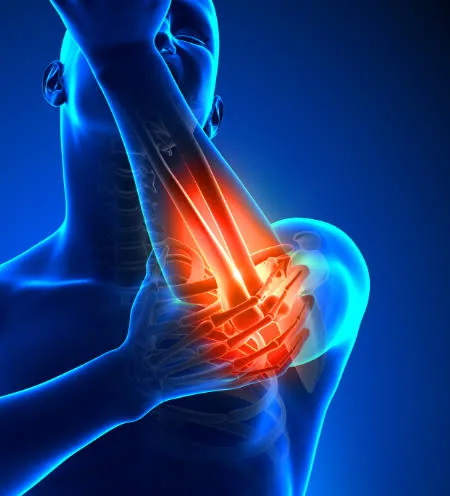
Shoulder/Upper Arm

Shoulder illustration
Shoulder
Upper Arm illustration
Upper Arm

Common injuries in this area

Rotator cuff strain

What it is

Irritation or small tears in the group of four muscles and tendons that hold the top of the arm bone in the shoulder socket and let you lift and rotate the arm.

Why it happens

Repeated overhead movement in sports like baseball, tennis, swimming and weightlifting wears the tendon tissue down over time. In teenagers it is usually overuse rather than a full tear.

Shoulder dislocation

What it is

The ball at the top of the arm bone comes fully out of the shoulder socket. The shoulder looks visibly out of shape, is very painful, and cannot be moved normally.

Why it happens

A fall on an outstretched arm, a tackle, or a forceful twist with the arm raised. Once a shoulder has dislocated, it is more likely to happen again, particularly in younger people.

Collarbone (clavicle) fracture

What it is

A break in the collarbone, the long bone that runs across the top of the chest from the breastbone to the shoulder. It is one of the most common fractures in children and teenagers.

Why it happens

A fall directly onto the shoulder, a fall on an outstretched arm, or a direct hit, common in cycling, football, rugby, skateboarding and skiing.

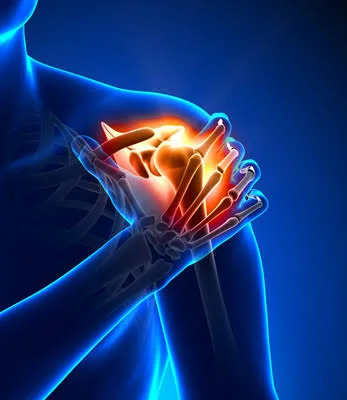
Exercises

If something hurts, stop. These exercises support recovery and prevention; they do not replace a doctor or physiotherapist.

For rotator cuff strain (prevention and recovery)

External Rotation with a Band

  1. Hold a resistance band with your elbow bent to 90 degrees and tucked against your side
  2. Rotate your forearm outwards, keeping your elbow still, then return slowly
  3. Repeat 10 to 15 times, 2 to 3 sets

Wall Slides

  1. Stand with your back against a wall, arms bent in a "goalpost" position
  2. Slowly slide your arms up the wall, keeping contact, then back down
  3. Repeat 10 times, 2 sets

After a shoulder dislocation (only once a doctor has cleared you to exercise)

Pendulum Swings

  1. Lean forward with your good arm resting on a table, letting the injured arm hang
  2. Gently swing the arm in small circles
  3. 30 seconds each direction, 2 to 3 times daily

Isometric Shoulder Holds

  1. Stand side-on to a wall with your elbow bent to 90 degrees
  2. Push the back of your hand gently into the wall without moving
  3. Hold for 5 seconds, repeat 10 times, then turn and repeat with the palm

After a collarbone fracture (only once a doctor has cleared you to exercise)

Elbow and Wrist Movements

  1. While the arm is in a sling, gently open and close the hand and bend and straighten the elbow
  2. Repeat 10 times, several times daily, to keep the arm from stiffening

Shoulder Blade Squeezes

  1. Once cleared, sit tall and squeeze the shoulder blades together and down
  2. Hold for 5 seconds
  3. Repeat 10 times, 2 to 3 times daily

Common questions

How do I know whether a shoulder injury is a strain or something worse?

A strain usually builds up gradually, aches deep in the shoulder, and hurts with overhead movement or at night. A dislocation or a fracture follows a specific fall or hit, causes severe pain straight away, and often leaves the shoulder or collarbone looking out of shape. Sudden weakness in the arm after an injury, or a shoulder that will not move, needs a doctor immediately.

Should I keep playing through shoulder pain?

No. Rotator cuff problems get worse with continued overhead use, and the exercises that fix them only work if you also rest from the activity. If the pain has not improved after a couple of weeks of rest, or if it disturbs your sleep, see a doctor or physiotherapist.

How long before I can get back to sport?

A mild rotator cuff strain usually improves over a few weeks. A dislocation needs the shoulder put back by a medical professional, followed by weeks of rest and rehabilitation, and a broken collarbone usually takes six to twelve weeks to heal in teenagers. In every case, return to sport should be guided by a doctor, not by how the shoulder feels on a good day.

Had a Shoulder/Upper Arm injury? Share it in the Injury Archive, open from 30 October to 30 November 2026.

Join our Newsletter

Subscribe to our newsletter and never miss a story.

We care about your data and never share your email.